Copyshop: Tracing a Dissapearing Infrastructure
The copyshop as a creative space is disappearing from the urban landscape. For decades, it was a network, a studio for artists, and a collaborative space where knowledge was negotiated. As Kate Eichhorn demonstrates in her work on xerography, copyshops were essential infrastructure for activist and subcultural archiving. For the punk movement and marginalized groups, they offered low-threshold, direct access to the means of production. Here, material was duplicated, published, and bootlegged without the control mechanisms of established publishers, enabling a resistant counter-public sphere to emerge. Flyers, mail art, and zines became the carriers of this unregulated circulation. Eichhorn makes it clear that the photocopy was not merely a technical reproduction process but a practice that made marginalized knowledge visible, transmissible, and durable in the first place. Today, these physical nodes are giving way or simply standing empty. With them, a specific, material form of knowledge production is vanishing.
The Open Call is intended as a homage to them. The archive is to secure and remember, unruly places of publishing.
We don’t mourn. We celebrate. And publish.
I
La copisteria sta scomparendo dal paesaggio urbano. Per decenni è stata una rete, uno studio per artiste e uno spazio collaborativo in cui si negoziava il sapere. Come dimostra Kate Eichhorn nel suo lavoro sulla xerografia, le copisterie erano infrastrutture essenziali per l’archiviazione attivista e subculturale. Per il movimento punk e i gruppi marginalizzati,offrivano un accesso diretto e a bassa soglia ai mezzi di produzione. Qui il materiale veniva duplicato, pubblicato e anche piratato senza i meccanismi di controllo delle case editrici tradizionali, permettendo l’emergere di una controsfera pubblica di resistenza. Volantini, mail art e fanzine divennero i vettori di questa circolazione non regolamentata. Eichhorn chiarisce che la fotocopia non era solo un processo di riproduzione tecnica, ma una pratica che ha reso il sapere marginalizzato visibile, trasmissibile e duraturo. Oggi, questi nodi fisici cedono il passo o rimangono semplicemente vuoti. Con essi svanisce una forma specifica e materiale di produzione della conoscenza.
L’Open Call è concepito come un omaggio a loro. L’archivio non vuole essere nostalgico, ma salvaguardare e ricordare,perché questi spazi non sono ancora del tutto scomparsi.
Der Copyshop verschwindet aus dem Stadtbild. Über Jahrzehnte war er Netzwerk, Atelier für Künstlerinnen und Gemeinschaftsraum, in dem Wissen verhandelt wurde. Wie Kate Eichhorn in ihrer Arbeit zur Xerografie aufzeigt, waren Copyshops essenzielle Infrastrukturen für aktivistisches und subkulturelles Archivieren. Für die Punk-Bewegung und marginalisierte Gruppen boten sie einen niedrigschwelligen,direkten Zugang zu den Produktionsmitteln. Hier wurde ohne die Kontrollmechanismen etablierter Verlage vervielfältigt und publiziert und auch geraubkopiert, wodurch eine widerständige Gegenöffentlichkeit entstehen konnte.
Flugblätter, Mail Art und Zines wurden zu Trägern dieser unregulierten Zirkulation. Eichhorn macht deutlich, dass die Fotokopie nicht nur ein technisches Reproduktionsverfahren war, sondern eine Praxis, die marginalisiertes Wissen überhaupt erst sichtbar, zirkulationsfähig und haltbar machte. Heute weichen diese physischen Knotenpunkte oder stehen schlichtweg leer. Mit ihnen verschwindet eine spezifische, materielle Form der Wissensproduktion.
Der Open Call ist als Hommage an sie gedacht. Das Archiv sichert und erinnert und gibt einen Anlass über diese Infrastruktur des Publizieren zu reden.
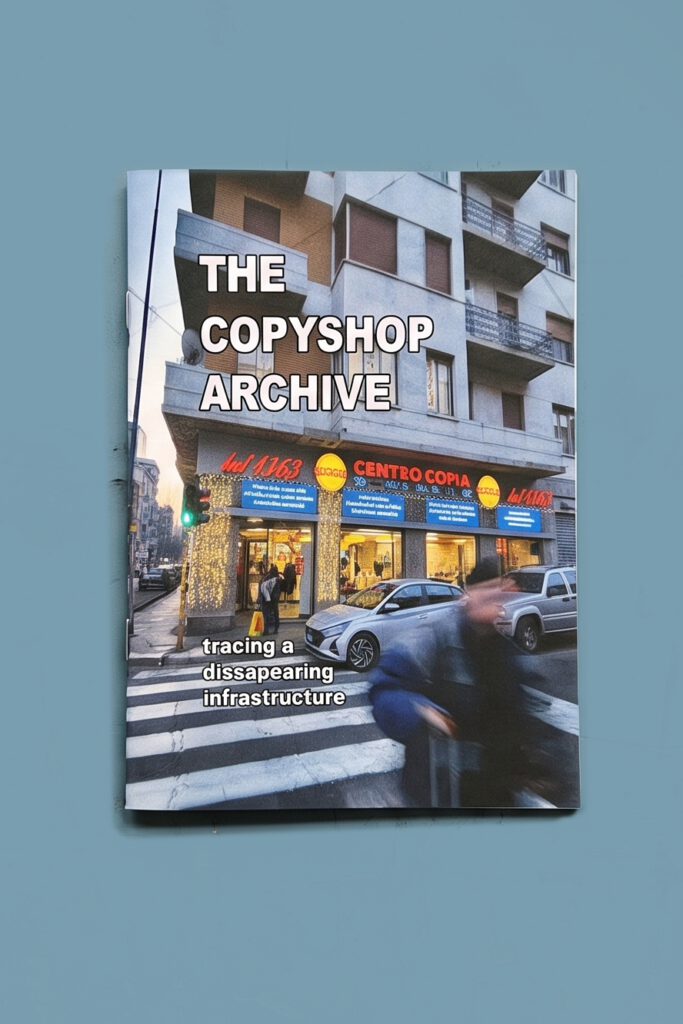
First Publication: Sprint Milano 27. Nov. 2026
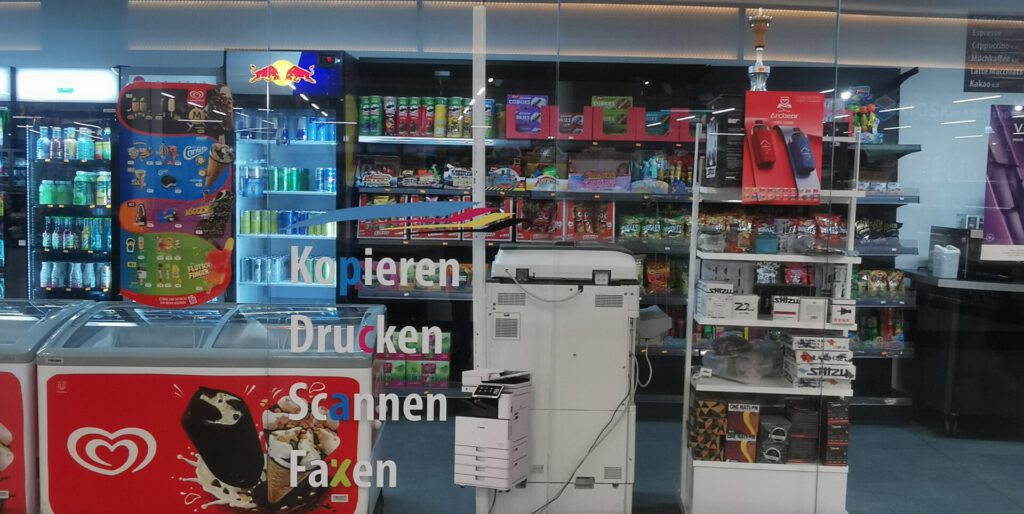
With the following submissions: #1 – Centro Copia Digitale #2 – Toner & Tinte #3 – EFKECOPY #4 – Lotto Bayern / Copyshop #5 – Unser Kopierladen Schug & Real GbR #6 – Kerpener Str. (Copy-Druckhaus) #7 – Kopieren Drucken Scannen Faxen #8 – Entre d’Impressió / Copisteria #9 – Seraing, Liège (Copy Color 9.17) #10 – Tilburg (Copy & Co) #11 – Zürich (Copy Quick Digital AG) #12 – Nacogdoches, Texas (Copy Center NAC),#13 – Bacolod, GT Mall 888 (EBG T-Shirt)
Frequently Asked Questions
How does this Open Call function? This Open Call stays open without a deadline. I will publish a Zine with around 20-30 submissions every 2-3 months. As long as your submission depicts a copyshop anywhere in the world and you guarantee that you hold the rights to allow me to publish it, it will be included. The individual Zines are printed in a limited edition of 100. You will receive a note when the zine is printed, where it will be presented, and an invitation to join the launch.
How do I get a physical copy of the printed Zine? For now, the project funding is not sufficient for me to send copies to all contributors automatically. However, if you send a donation to cover production and shipping, I will mail you a physical copy.
What exactly should the photos show? Storefronts, facades, window displays, or signs of copyshops, print shops, and copy centers. They can be currently operating, completely abandoned, or repurposed. The focus is on tracing this specific,disappearing infrastructure in the urban landscape.
What information do I need to include with my submission? Please provide the name of the copyshop (if visible/known), the exact location (city and country, street address if possible), and the name you would like used for your photo credit.
Are there any technical requirements for the image files? Please send high-resolution images so they can be printed clearly in the A5 zine format. Standard formats like JPG or TIFF without heavy filters or watermarks work best.
Do I retain the rights to my photos, and is there compensation? Yes, you retain full copyright of your images. By submitting, you are simply granting the non-exclusive right to publish the photo in the Copyshop Archive zines and related archival presentations. Because this is an independent, non-profit archiving project, there is no financial compensation for submissions.